Promised at 12:04, Served at 12:19: The Feedback Revolution Against McDonald's Broken Tech Promises

Photo: albinfo, CC0, via Wikimedia Commons
The notification is so confident. "Your order is ready!" it chirps, while you're standing in a lobby that has never heard of you, staring at a curbside pickup spot with no attendant in sight, or watching the pickup timer tick from 12:04 into 12:19.
Welcome to the fastest-growing complaint category in McDonald's feedback channels: the gap between what the app promises and what the store delivers. And according to what's showing up in survey responses, customers have officially run out of patience.
The New Complaint Playbook
Traditional McDonald's complaints were physical: cold fries, wrong sauce, a drive-thru order missing the straw. Mobile order-ahead complaints are a different species entirely, and they follow recognizable patterns:
The Phantom "Ready" Notification. The app says ready; the store says otherwise. Survey comments in this vein are brutal in their simplicity — customers describe standing in a crowded lobby, holding a phone that insists their food is waiting, while staff insist it isn't.
The Curbside Limbo. You check in, you park in spot 3, and then... nothing. No crew member, no countdown, no way to signal anyone. Some customers report giving up and walking inside, defeating the entire purpose of the feature.
The Locker Shuffle. Pickup lockers were pitched as friction-free. Instead, customers describe lockers that won't open, codes that don't register, orders placed in the wrong compartment, and food that's gone lukewarm by the time the door finally swings wide.
The Timing Fiction. Perhaps the most galling: the app's estimated ready time. When a 10-minute promise turns into a 25-minute wait, the customer didn't just lose time — they lost trust in the number itself.
Why This Complaint Category Grew So Fast
Digital order-ahead adoption exploded, and with it, the surface area for failure. A drive-thru mistake affects one car at a time. A mobile order system that misfires affects every customer in a store simultaneously — and each of them is holding a device perfectly suited for expressing displeasure, both on social media and, yes, in the survey.
There's also a psychological dimension. When you order at the counter, a delay is just a delay. When the app tells you it's ready and it isn't, that's a broken promise from a system that's supposed to be smarter than the lobby. Customers rate promise-breaking more harshly than mere slowness, and survey scores reflect it. An order ten minutes late with an accurate ETA scores better than an order ten minutes late with a wrong one.
What the Survey Data Is Telling McDonald's
Feedback patterns point to a consistent root cause: the app operates on corporate timelines, while the store operates on staffing reality. The ready-time algorithm doesn't know that the grill crew is down two people. The curbside feature doesn't know the assigned runner is covering the drive-thru. The locker system doesn't know nobody's been trained on it this shift.
The survey responses capturing these failures are unusually actionable, which is why they're getting attention. Unlike "food was cold," a mobile complaint often includes timestamps, order numbers, and a specific feature that failed. That granularity lets corporate separate an app problem from a staffing problem from a training problem — three very different fixes.
What You Can Do When the Tech Lets You Down
If a mobile order goes sideways, your survey response is more useful than you might think. A few tips for making it count:
Name the feature. "Mobile order-ahead curbside check-in failed at store #XXXXX" routes better than "service was bad."
Compare promise to reality. Write down the app's ready time and your actual pickup time. That delta is the exact metric McDonald's tracks.
Note whether anyone helped. Stores that recover well from tech failures score very differently than stores that leave customers stranded. Both data points matter.
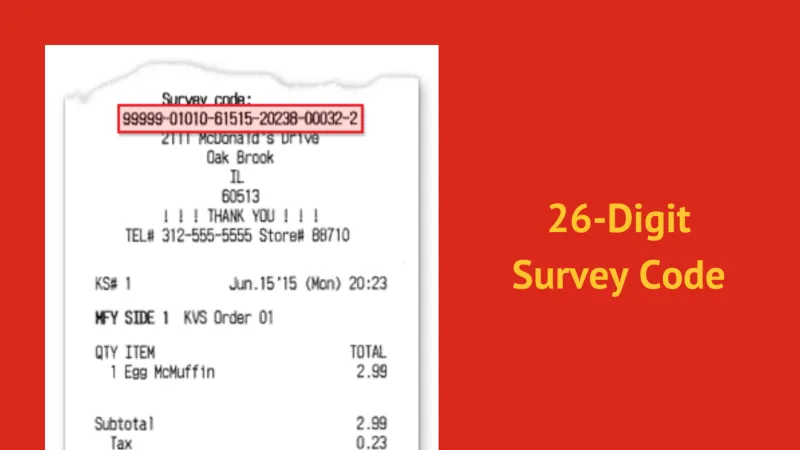
Use the survey, not just the app's rating. The in-app star rating evaporates into the void. The survey response follows the receipt — and the receipt follows the store.
The mobile app was supposed to be McDonald's answer to a decade of digital disruption. In practice, it's created a new class of disappointment — and a new reason to spend five minutes with a receipt. If the Golden Arches wants the convenience promise to mean something, it'll be because customers like you kept pointing out, in exhaustive detail, exactly where the promise broke.